Mythic Bastionland- My First session & Subverted Expectations
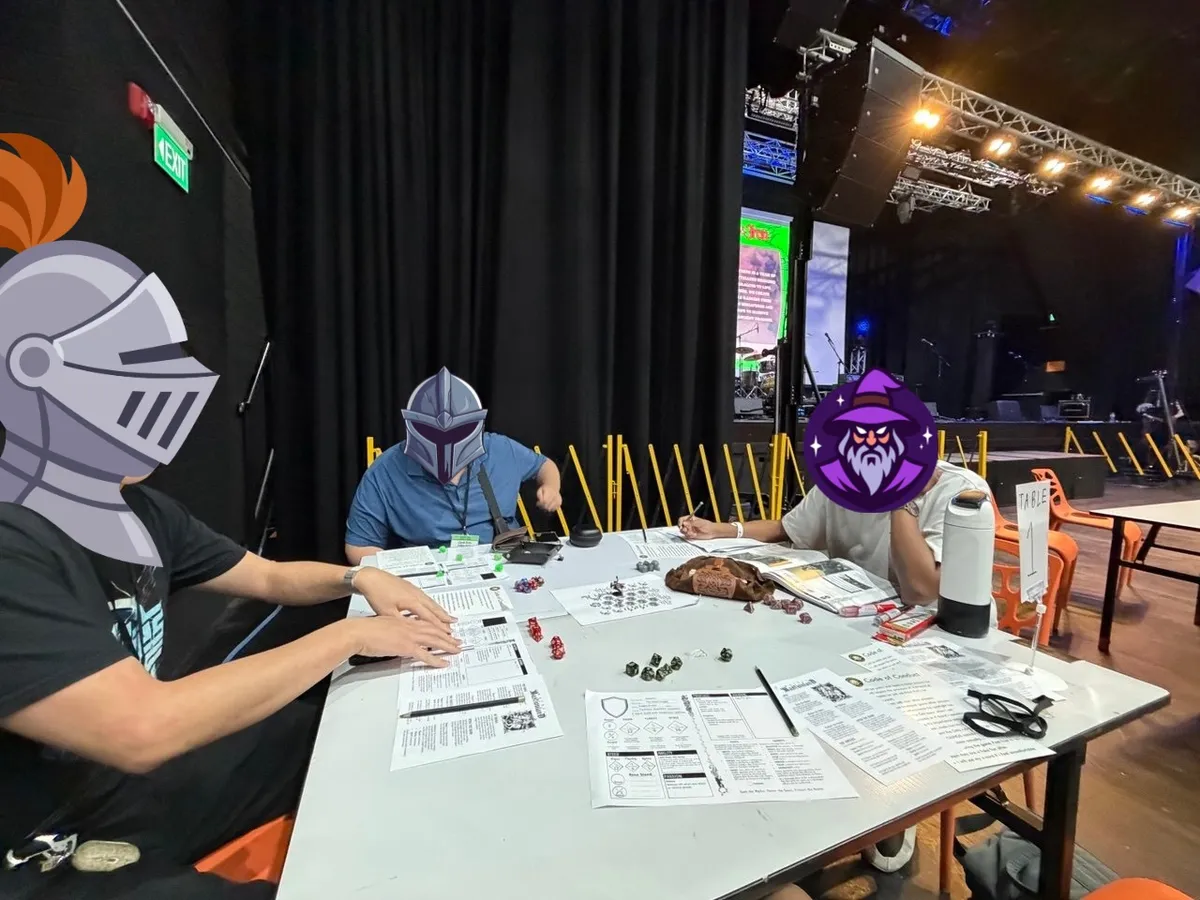
On 12 April 2026, my friend and I paid to join a public taster session of Mythic Bastionland (McDowall 2024) run by local studio- The Alternative RPG Club. Loyal to their namesake, they are doing a great job of bringing a wide variety of non-5E TTRPGs to players here in Singapore, from Trad to OSR and PBTA!
This session was held wider festival called Spell & Iron which is an ambitious to effort to meld live heavy metal music, Tattooing, RPGs, LARP, and all things fantasy! While the entrance fee to the main festival ground was a tad prohibitive, the festival had a cozy, buzzing atmosphere. What a surreal experience to be playing a game about knights in a mythical realm and be interrupted mid-game by the clangour of sword on armour from the HEMA demonstration a distance away. Kudos to the organisers for dreaming this up and looking forward to the next one!
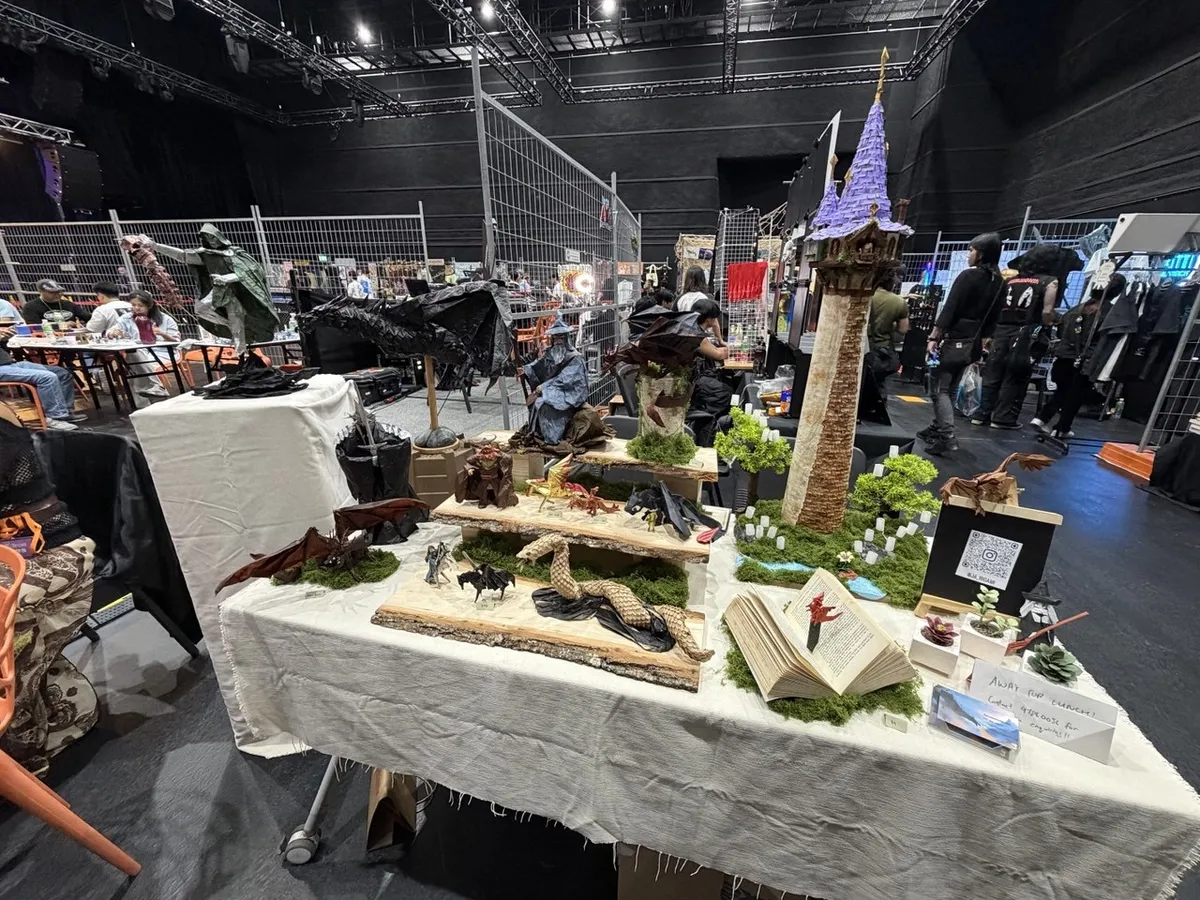 This local origami biz was super cool and had great conversations with many local creators!
With the shoutouts out of the way, let’s talk about my experience playing two hours of Mythic Bastionland!
Setting the Table
After a quick introduction (we were matched with one other player and also our Referee), we were given a very brief primer on Mythic Bastionland “You are all knights who follow a code of chivalry. Think King Arthur”. This was made even clearer in the pithy trio of tenets written in the rulebook:
Every Knight has sworn the Oath:
SEEK THE MYTHS
HONOUR THE SEERS
PROTECT THE REALM
I think this is one of MB creator’s Chris McDowall’s Strengths. He’s able to condense ideas economically yet evocatively on page, which makes for quick reading and reference. REF also provided each a printed handout of the basic rules (Essential reference, esp during combat). He also indicated our starting point, a castle in the middle of a hexmap. We each randomly selected a knight from a stack of pre-made sheets, and then it was off to seek out and slay a mysterious Beast plaguing the realm!
To avoid spoilers, I‘ll tell you that REF ran one of the 60 unique scenarios (called Myths) from the book titled The Beast. The session covered the basics of hexcrawling, and was mostly combat focused. My efforts to "Moana" the Beast (parlay with the monstrosity) unfortunately bore little fruit and unfortunately had to opt for extermination. Ofc with RPGs, mileage will always vary based on DM fiat and context. The session ended with our brave knights felling The Beast, my knight having traded her life for the coup de grace, which I thought was a nice dramatic finish :D.
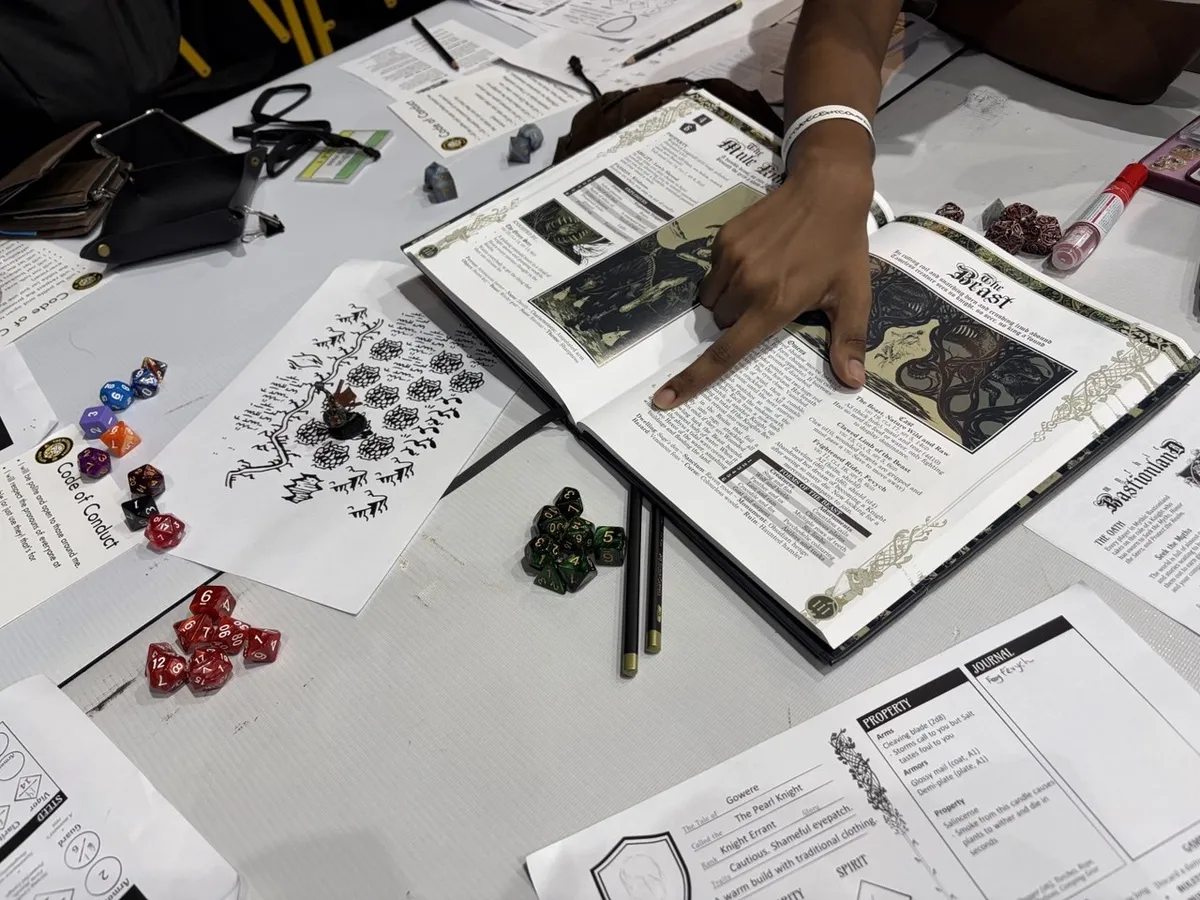 REF showing us the page of MB and how the myth of The Beast was laid out and written to be run
This was my first ever game of MB but I some expectations going in. Here are some expectations that were very positively subverted
Expectation 1: Mythic Bastionland is just reskinned Electric Bastionland
Before MB, we had gonzo victorian steampunk game Electric Bastionland (McDowall 2020). While EB was a hefty tome chock full of masterful worldbuilding, fantastic illustrations, super good GM advice and a 100 creatively designed character classes (known as failed careers), it was still more or less built on the same two- page ruleset as McDowall’s previous cult hit Into the Odd (2024).
The ItO ruleset is mostly popular for:
- only 3 ability scores,
- a d20 roll under system,
- characters always hit on their attacks and you roll directly for damage
- a very basic armour system and very small numbers as HP. The popularity and power of the ruleset lay in its simplicity and barebones approach to gaming.
My expectation as a result was that McDowall’s new game Mythic Bastionland would be more of the same ItO, just reskinned for fantasy! Nothing wrong with that (I ran a 6 session campaign of EB and loved it) but I assumed MB's innovation would mostly be left to the setting and class designs, and McDowall wouldn’t change the core mechanics too much. I am glad to say I was proven wrong!
MB’s basic combat rules does still retain most of the ItO chassis but its added combat rules count for a lot in terms of tactical and thematic depth. Most notable in the combat rules are additional subsystems known as Feats and Gambits.
Feats are additional bonuses you may choose to add to your knight's attack. Smite allows you to add an additional d12 to your attack or hit multiple enemies. Focus allows you to perform a Gambit without spending dice (more on that later), and Deny allows you to forgo your own attack dice to prevent enemy damage on yourself or your ally! If Feats sound overpowered, it is because they are! The drawback to using a Feat during your attack is having to pass a d20 ability save after, or be fatigued. A knight that’s fatigued can’t execute Feats for the rest of the combat! What a simple way to balance power with attrition in battle!
I will avoid getting into the second sub-system Gambits, but it essentially allows players to discard attack dice with results >=4 to impose conditions on the target. You could stun an enemy, weaken their next attack, or even dismount them from their steeds! Also it’s exciting that MB is designed to give players more dice to roll per attack. The more dice with high results the more Gambits you could pull off!
These new rules definitely give the game a bit more of a learning curve, but it never felt too overwhelming, even as we were learning on the fly. More importantly, these decision points felt weighty, and encouraged collaboration between players. There was an instance when my ally would spend his Feat to protect me from taking fatal damage, while I discarded dice to a execute a stun on the enemy, preventing its escape, and ensuring the kill next round. I think the game captures the catharsis of playing coop boss battling videogames like Monster Hunter and Elden Ring.
Of course combat is just one aspect of an RPG, and we should expect other facets of the game (roleplaying, exploration, problem solving) to be equally satisfying. Thankfully McDowall has already proven that his evocative writing and class design does alot of heavy lifting in sparking interesting RP and problem solving opportunities.
Like in EB with its 100 failed careers to choose (or more likely roll) from, MB has a 100 different unique knights that you could potentially be, all with their own strange powers and accompanying steeds. My knight was the Pearl Knight, and she creates a pearl once every morning that allows her to see from the eyes of a person who possesses that pearl. Just reading her ability already sparked so many ideas in my head on how we could use this power to solve interesting challenges and obstacles. My friend also could not help but laugh when he glanced my character sheet . "Why does your character have a shameful eyepatch?" In that moment we found ways to roleplay and banter, my character adopting an insecure persona, hiding the unfortunate ritual of producing once mucus- ridden magical pearl from her eye socket every morning. I knew then that MB still retains its weird gonzo quality that I came to love from playing EB.
Expectation 2: Mythic Bastionland’s setting is just medieval fantasy.
Even though I caught wind that MB was a game about Knights, it did not immediately dawn upon me that it would lean in so hard on the subgenre of Arthurian fantasy. A big reason why I passed on reading the PDF of MB even though I had backed the kickstarter, was mainly because I thought it would be like every other medieval fantasy ttrpg thats out there. I don’t mean to discredit the “forgotten realms”-esque fantasy genre, i play those RPGs all the time. I just thought MB would be something similar to Cairn (which also more or less uses the ItO ruleset), and so I decided to skip looking at it, in search of other RPGs that promised genres less familiar to what we are so used to getting.
I was thus pleasantly surprised that we are expected to fully commit to being chivalrous knights, all with our own steeds and sworn oaths. I also like that the book has no guidance for knights that renounce or deviate from their oath (my friend asked REF and it was a fair qn). There's no wiggle room, and no way to feed into desire lines if there's no rules for the game. The game is focused on everyone being honorable knights, and if players want to do differently, its an additional rulings tax on the REF, which is also a good way to nudge the players to try the game's core conceit and design, or maybe play something else more suited.
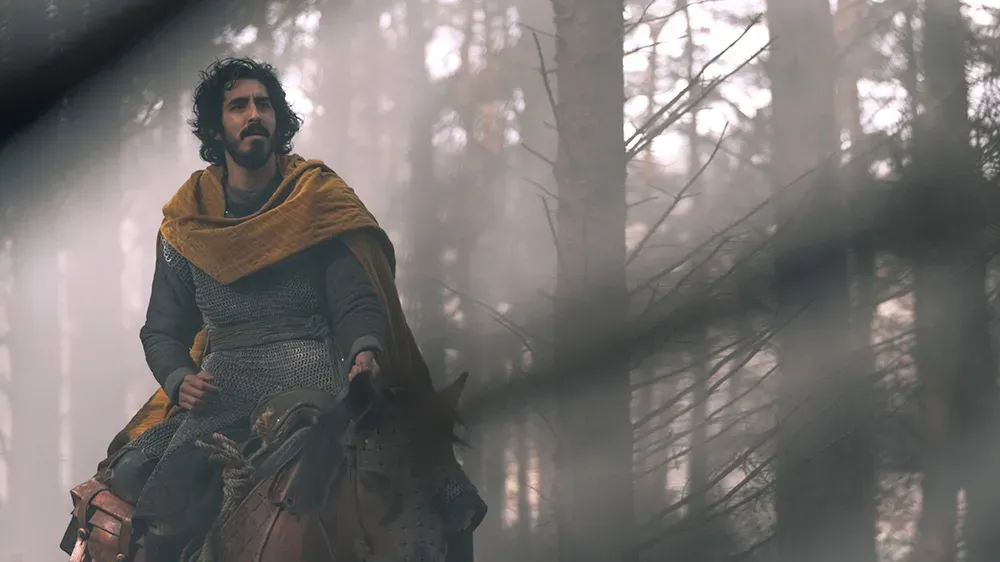 Credit: A24/Everly Collection
As we were playing MB, I found the easiest filmic reference I could draw to the feeling that it gave me is The Green Knight (David Lowery, 2021) which is a weird revisionist filmic take on the Sir Gawain and the Green Knight story. The woods we were exploring felt lush and alive with a magic wild and beyond understanding, and the hexcrawl lent well to giving the game a sense of structure. we later learnt after the game, from debriefing w REF, that MB’s rulebook comes with a list of different Myths, and interesting things that the REF would litter throughout themap. It sounds like this game relies quite heavily on hexcrawls and at least planting some myths, which leads me to my last expectation positively subverted
Expectation 3: Mythic Bastionland might be more GM guidance focused, and GM tools scarce
Once again, my expectation is based on McDowall's previous game EB, which I have more experience with. I think I played MB expecting the same design ethos that McDowall seemed to espouse in his design of EB. In EB, the core rules are simple and frontloaded, and the game requires very little beyond character sheets, dice and imaginative players. I think McDowall did a brilliant job making the rulebook more or less a book of best practices beyond the core rules and character creation section. "This is a game to be played, not a textbook to be studied. It’s designed for the game table, not the library." (Electric Bastionland 332).
For that reason, when I was the GM for EB , I felt I could really embrace the thrumming, chaotic quality of the game's lacunous design, and think up stories and scenarios of my own (sometimes on the fly) instead of referring to the book, which does not provide many statblocks nor any specific landmarks or detailed geography. "No two visions of Bastionland are quite the same. Your Bastion will draw from the city you live nearest to... imagine your own expression of them. Most importantly you will understand how to create a world that serves your game. This is a world discovered at the table, not inside a book." (237).
It seems like MB is inversely, fitted with tools and procedures. From what i gathered from speaking w REF, MB has a lot more specific instructures to help Referees build their hexmap of Bastion. I also did see REF referring to the book quite a bit when describing the Myth we were up against. Another GM from ALT RPG also excitedly shared how the game also has rules for domain level play as well, with knights will travel in bands and retinue, or even politic as lords of their respective realms ala A Game of Thrones. Almost from a top down, real life strategy perspective. “So it’s abit like Spore!” I exclaimed, revealing a lot about my age and poor taste in videogames.
Conclusion
I had a blast trying Mythic Bastionland! It’s quite different in feel from Electric Bastionland, or any other fantasy RPG I’ve played. I like that it still feels rules light while still promising strategic depth and cooperating. It also seems to be designed to support campaign and domain style play if your party is so willing. There’s a lot to like here for GMs and players!
So What's Next?
I'm definitely very keen to find out more about Mythic Bastionland and Chris McDowall's decisions on designing a game that feels pretty different from his previous endeavours. I think trying this game has only increased his esteem in my eyes, and realising how great and versatile he is as an RPG designer. Here are some things I'm intending to do now that I've tasted what a bit of Mythic Bastionland plays like:
- Read the actual rulebook. Should I read the myths and run the game for friends as a Referee, or refrain from spoiling myself from experiencing the game, and try to find someone who would table the game with me as the player? We will have to see!
- I am really interested in learning how McDowall designs and presents his myths in an economical way. I might also complement my reading of MB's myths, and McDowall's blog with reading the rules and supplements from another game Forbidden Lands (Fria Ligan 2018), which i know has some great content for Hexcrawls as well. I have always harboured dreams of designing a large hex sandbox for friends to play in.
- I think I can finally watch those YouTube videos about MB that have been aggressively recommended to me. As much as I love Quinns' Quest and his passionate reportage, his videos compel me to add his great recommendations to my already burgeoning list. I also avoid videos of games I am intending to review as I don't want my personal thoughts to be influenced by creators whom i admire deeply. Curse you Quinns and your decades of great boardgame/videogame review content of which I am deeply envious!!